
Poster
Optimized Strategies for Bispecific Antibodies Manufacturing
Optimized Strategies for Bispecific Antibodies
Manufacturing
ABSTRACT
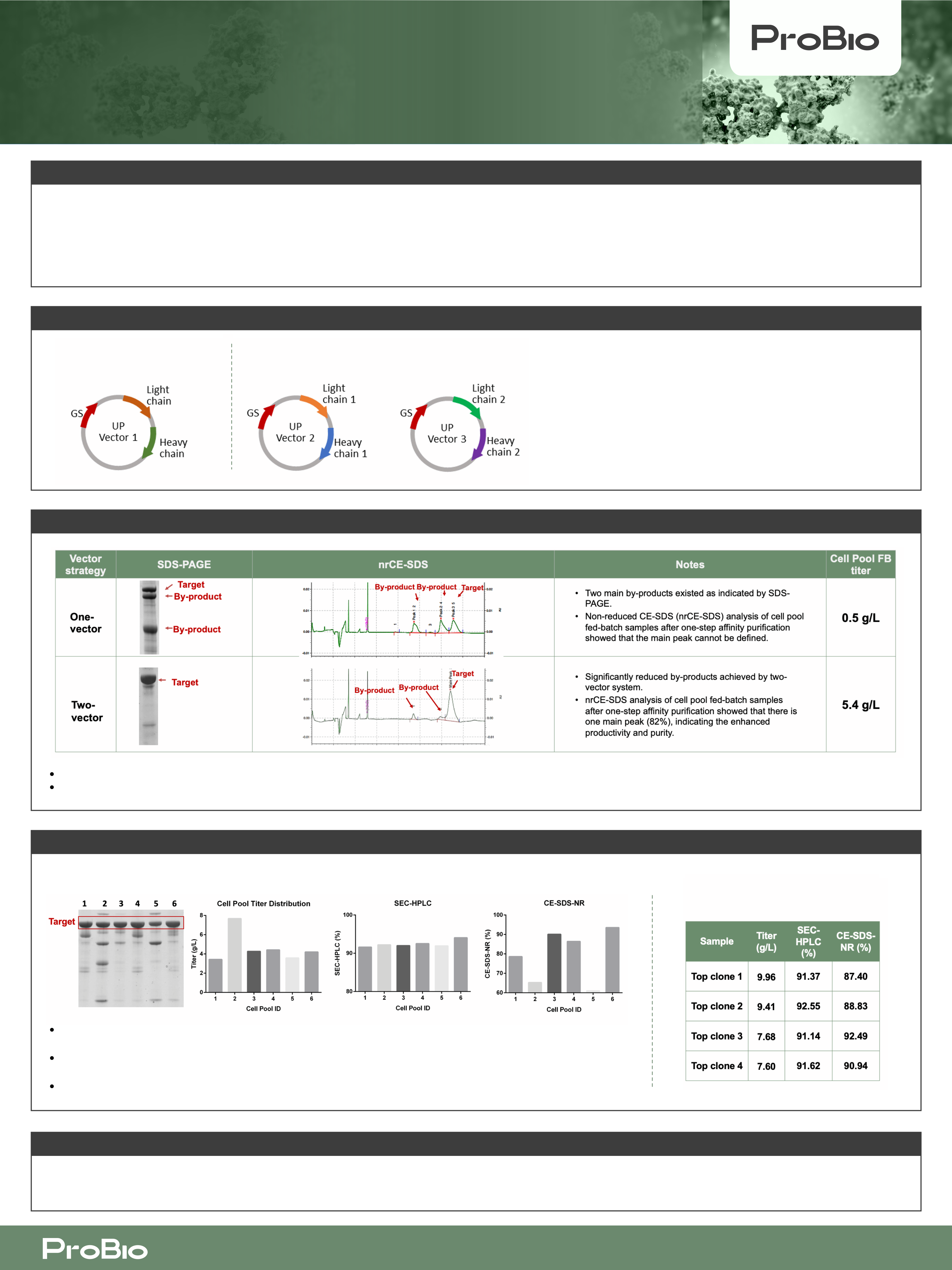
Bispecific antibodies (bsAbs) have become increasingly important in clinical applications. However, assembly of bsAbs with correct polypeptide chains is
one of the major challenges in their production. Random assembly of distinct heavy and light chains leads to non-functional or monospecific impurities.
Controlling the relative expression of different polypeptides is the key in the process of manufacturing bsAbs. Here we optimized the vector strategy in
ProBio’s Cell Line Development platform (ProCLD) to achieve bsAb manufacturing with high yield and purity. The production and quality can be greatly
improved by modulating the expression of distinctive polypeptide chains and thereby optimizing the correct assembly of bispecific antibodies. At ProBio,
we identify the vector ratio allowing the highest instance of correct assembly at an early stage during cell line development to ensure optimal production.
OPTIMIZED VECTOR SYSTEM TO PRODUCE BISPECIFIC ANTIBODY IN CHO-K1 CELLS
One-vector system for mAb
Two-vector system for bsAb with multiple chains
To construct bispecific antibodies, we employ a two-vector
strategy aimed at achieving both high productivity and purity.
This approach involves utilizing two plasmids to express
different polypeptide chains separately, testing multiple
vector ratios during transfection allowing for better balance in
chain expression. Based on the results obtained in the early
stages, we proceed the project with the optimal settings that
yield the highest productivity and purity.
CASE STUDY 1: Asymmetric bsAb composed of two chains
Top 1 clone titer: 5.6 g/L
The top 1 clone showed superior productivity stability with deviation < 13% after PDL70 (6.9 g/L vs 6.0 g/L).
CASE STUDY 2: Asymmetric bsAb composed of three chains
Cell pool titer and quality performance
Top 4 clone performance
SDS-PAGE analysis of cell pool fed-batch samples after one-step affinity purification. Multiple patterns were
observed due to different vector ratio.
The titer of different cell pools is around 4 g/L. The titer of cell pool 2 is > 7 g/L. However, many by-products
contributed to the titer determination.
The cell pool with good titer and purity performance would be used for single cell cloning.
CONCLUSION
We have demonstrated that the construction of bsAbs with high yield and purity can be achieved by modulating the expression of selected polypeptide
chains. As presented in the cases, by identifying the vector ratio allowing the highest instance of correct assembly at an early stage, we enable a stable
and robust cell line development for the production of bispecific antibodies.