
White Paper
Late-stage Process Development and Cost of Good Reduction Strategies for Biologics

WHITE PAPER
Late-stage Process
Development and Cost of
Good Reduction Strategies
for Biologics
ProBioCDMO.com
Costly medicines are a burden for both individual patients and national budgets. The Prescription Drug Law within the
Inflation Reduction Act (IRA) exemplifies efforts to make medicines more affordable. The production of biologics
requires intricate manufacturing processes within a highly regulated environment, leading to high production
expenses. Greater control over the production costs of biologics has emerged as a pivotal factor for drug
manufacturers to uphold competitiveness in the biopharmaceutical industry.
After drug candidates enter clinical trials, the focus of Chemistry, Manufacturing, and Controls (CMC) often shifts
towards developing late-stage processes with the objectives of enhancing process stability and reducing production
costs per unit of drug substance (DS).
Taking monoclonal antibody products as an example, this article focuses on reducing the commercial production costs
of biopharmaceuticals. It explores two aspects: the timeline of late-stage processes development and factors in the
reduction of cost of goods (COGs) per unit of DS.
The timeline of late-stage process development
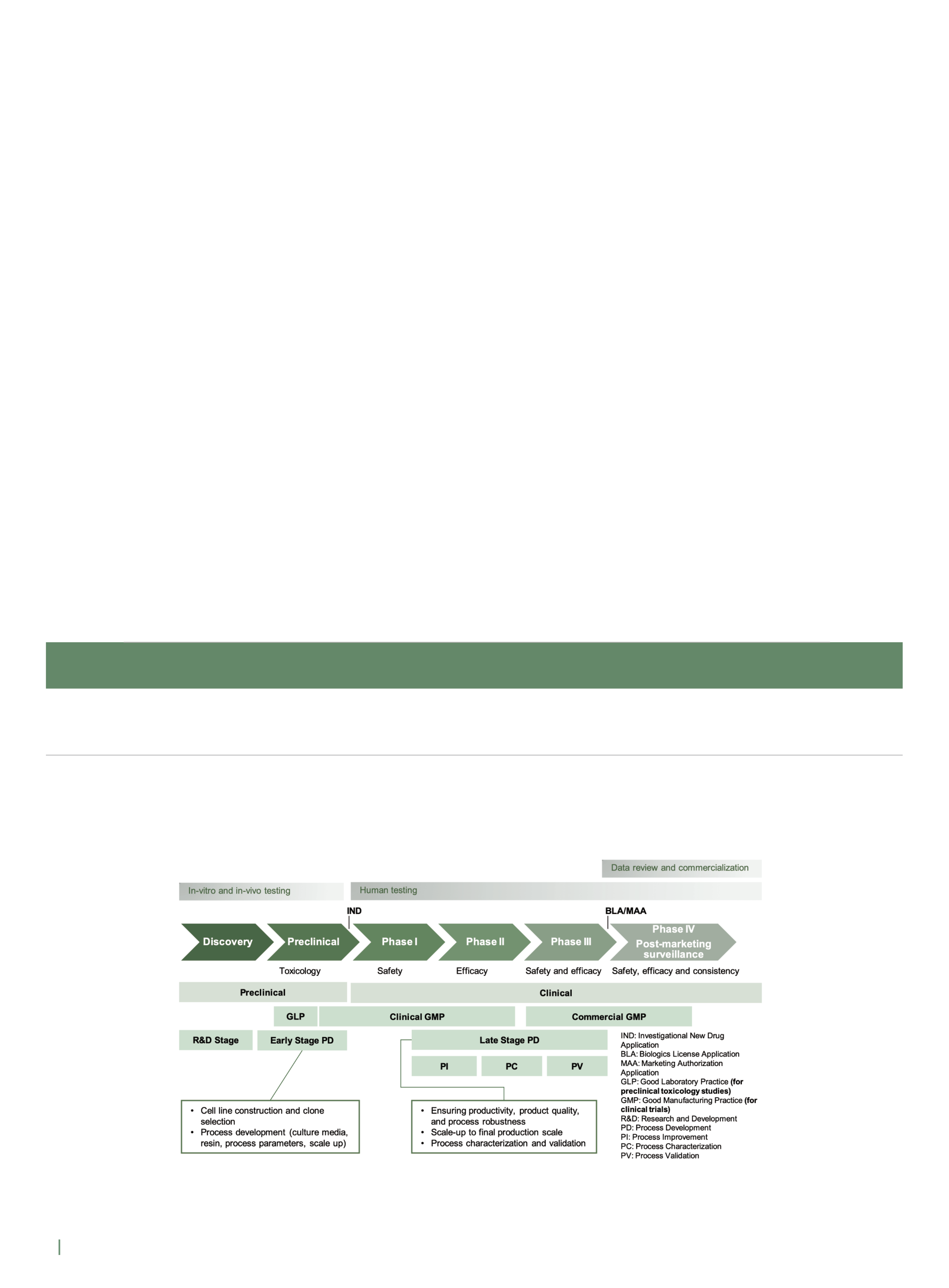
Late-stage process development can begin when the project enters Phase II clinical trials (Figure 1). From the overall
project lifecycle perspective, this smart strategy prevents wasting resources on projects that perform poorly in Phase
I clinical trials, while ensuring sufficient time for process development and subsequent clinical sample production
before the project enters Phase III trial. Once the project enters Phase III clinical trial, it’s not recommended to do any
significant process changes. Table 1 illustrates data published by Paul et al. on clinical success rates. This information
provides a basis for our strategic timing of late-stage process development, which demonstrates both cost and time
efficiency.
Table 1 Biologic product success rates at different stages
Regulatory
review
Overall
successful rate
Stage
Pre-clinical
Phase I
Phase II
Phase III
Average
successful
rate
69%
54%
34%
70%
91%
11.7%
The late-stage process development typically requires 6 to 8 months, with additional time allocated for stability data
collection and process change filling. Late-stage process development includes upstream process development,
downstream process development, formulation stability validation, and other tasks.
Fig 1 The development cycle of biopharmaceuticals and the content of early/late-stage process development
1
Late-stage Process Development and Cost of Good Reduction Strategies for Biologics
Factors that reduce production cost
The CoGs mainly includes fixed assets, operating expenses, raw materials, and consumables. Based on the actual
production model analysis, GenScript ProBio has established a comprehensive cost estimation system. The model
encompasses various production costs such as raw materials (media, substrates, and consumables), equipment and
facilities, quality control, labor, and energy/environmental costs. According to the model, the primary ways to reduce
production costs are ranked by effectiveness as follows: increasing upstream production yields, expanding the
production scale, and substituting costly media and materials with more economical alternatives.
a.Increasing upstream production yields
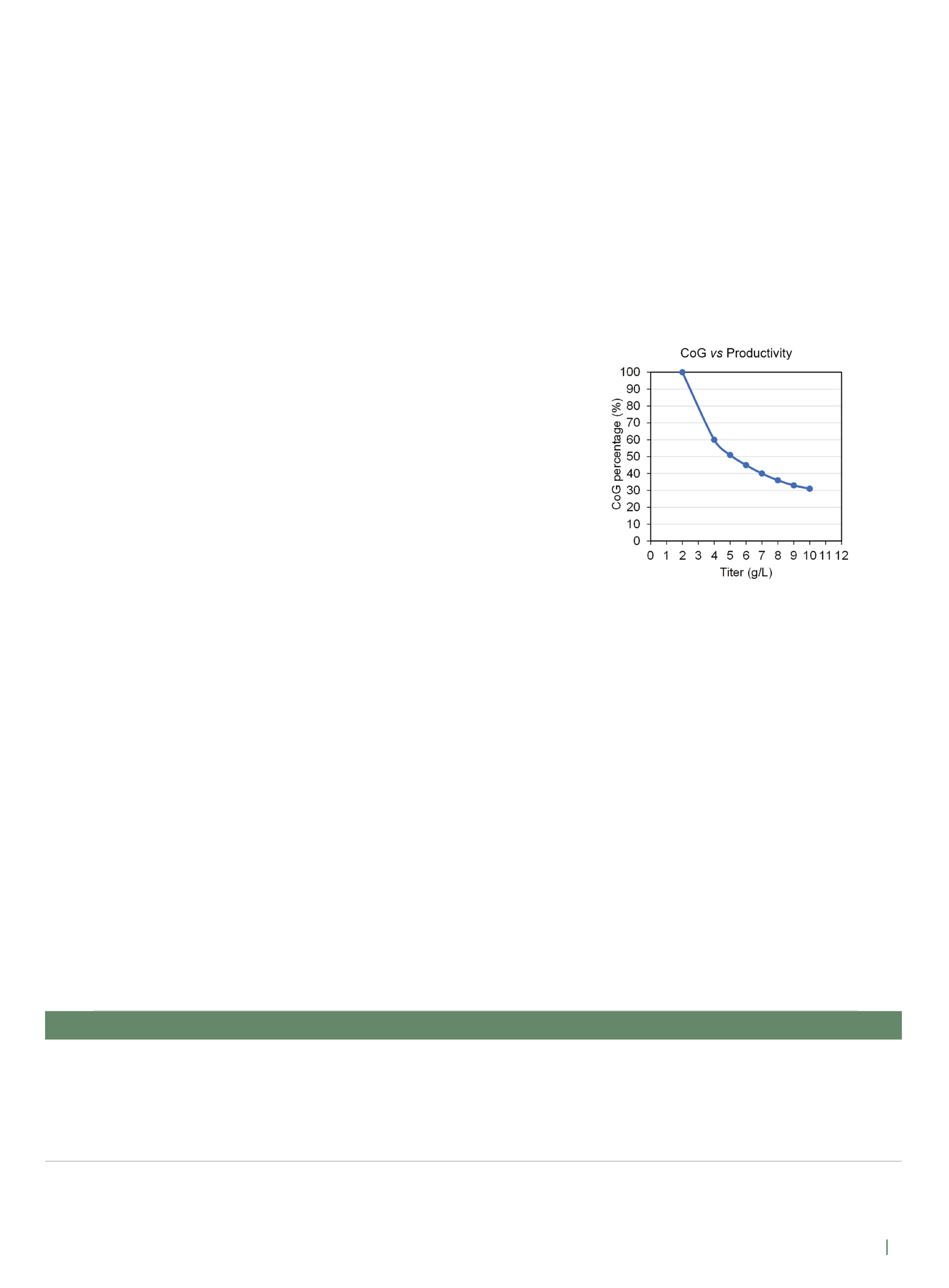
Increasing production yield is the most efficient way to reduce
CoGs. As production yield increases, fixed costs are spread across
a greater number units of DS, reducing the cost on a per-unit. As
shown in Figure 2, increasing production yield can rapidly decrease
the production CoGs per unit of DS. It's worth noting that there is
an exponential relationship between product yield and CoGs per
unit of DS. When product yield doubles, CoGs per unit of DS can
decrease by up to 40%. In late-stage process development, ProBio
aims to increase production yield while ensuring the product
quality remains comparable. This is achieved by methods such as
optimizing bioreactor process parameters, optimizing feeding
strategy, and implementing intensified fed-batch processes to
rapidly increase upstream process yields.
Fig 2 Upstream yield and production
costs (The data is generated from
ProBio's internal cost model).
In Figure 2, the x-axis represents titer of upstream process. Y-axis represents the CoGs per unit of drug substance with
different upstream titer. The CoGs per unit of drug substance at an upstream process titer of 2 g/L is set as 100% for
baseline
The easiest way to increase production yield is to perform process parameter optimization. Parameters like pH, tem-
perature, culture duration, feeding volume, and feed composition should be optimized to ensure the cells are cultured
under proper physical parameters with sufficient nutrient supply. Table 2 shows the outcomes of the upstream devel-
opment of a late-stage clinical project transferred to GenScript ProBio. The process development team made significant
yield increases through optimizing feeding strategies (including feed composition and feeding volume). The yield
increased by 95% compared to the early-stage process. Under the same conditions, CoGs per unit DS decreased by
nearly 40%, while the quality parameters remained comparable to the Phase I process.
Table 2 Phase I process and optimized process comparison
Content
Phase I process
Optimized process
Titer (g/L)
3.9
81
7.6
79
Harvest Viability (%)
CEX Main Peak (%)
64.3
96.3
64.5
97.3
CE-SDS-NR Main Peak (%)
ProBioCDMO.com
2
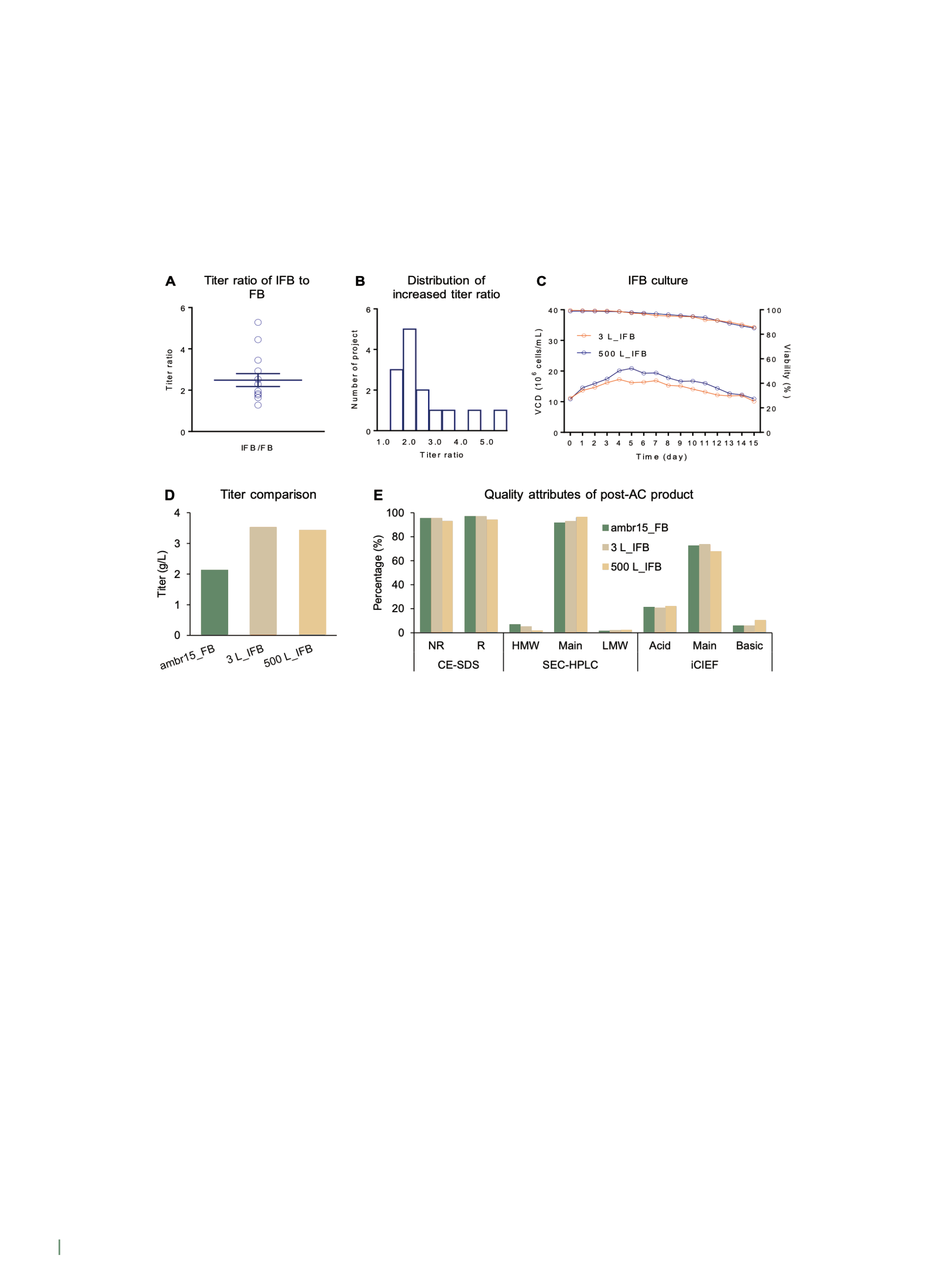
In addition to process parameter optimization, ProBio introduced the Intensified Fed-Batch (IFB) technology in 2021.
Unlike conventional fed-batch (FB) processes, IFB utilizes perfusion technology to significantly increase the N-1 cell
density, thereby enhancing the inoculation cell density in the production phase. This technology enables rapid yield
improvement. As shown in Figure 3A-B, in the application across 14 projects, IFB doubled the yield in the majority of
projects. According to Figure 2, these yield improvements are leading to significant reductions in CoGs per unit of DS.
Figures 3C-E demonstrate stable scale-up cases of IFB technology. In these cases, IFB processes were effectively scaled
up to 500 L, achieving approximately 60% increase in yield compared to the original process, while maintaining consistent
product quality.
Fig 3 IFB Increase upstream yield
A-B. Summary of IFB Project Applications. N=14 projects, data sourced from the maximum scale production yield of
each project. A. Titer comparison between Intensified Fed-Batch (IFB) and conventional fed-batch (FB). B. Distribution
of Titer increase ratio between IFB and FB. C-E. IFB Project Applications at 500 L Scale. C. Viable cell density profile
at 3 L and 500 L scales. D. Titer comparison between original FB process, IFB at 3 L scale, and IFB at 500 L scale. E.
Comparison of product quality after one-step affinity purification between original FB process, IFB at 3 L scale, and IFB
at 500 L scale.
b.Expanding the production scale
Scaling up production is another important approach when reducing production costs. Figure 4 shows a CDMO (Contract
development manufacturing organization)-based cost model which excludes factors such as facility depreciation and
labor costs. As shown in Figure 4, when the production scale increases from 500 L to 2000 L, the CoGs per unit of DS
reduces around 50%. When the scale is up to 4000 L, the CoGs per unit of DS is approximately 30% of the CoGs per unit
of DS at the 500 L scale. ProBio’s 8 × 2000 L disposable cell culture system, scheduled to be operational in April 2024,
will allow for a maximum production volume of 6000 L in scale-out mode, effectively reducing production costs.
When considering production scale, it's also crucial to take into account the production frequency which is typically
controlled within the range of 3 to 10 batches per year. Producing fewer than 3 batches per year can result in higher costs
for failed batches. On the other hand, when annual production exceeds 10 batches per year, increasing the production
scale may be considered. The best scenario varies depending on the project and requires a specific project-based
assessment.
3 Late-stage Process Development and Cost of Good Reduction Strategies for Biologics
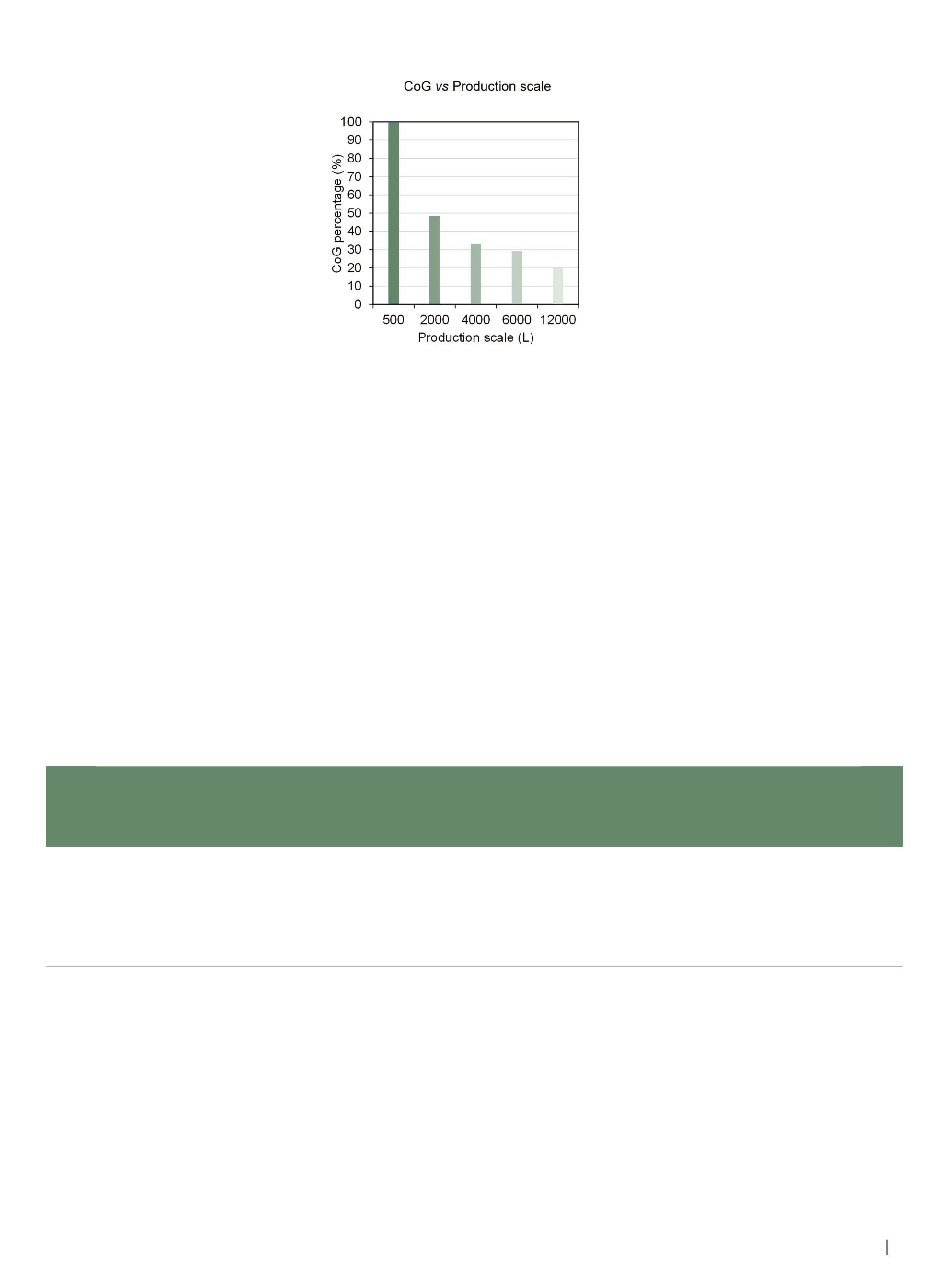
Fig 4 The relationship between production costs and production scale.
(The data is generated from GenScript ProBio's internal cost model)
X-axis represents the upstream production scale. Y-axis represents the CoGs per unit of DS. The CoGs per unit of DS
at 500L scale is set as 100% for baseline.
c.Replacing expensive raw materials
The cost of raw materials for biologic products accounts for 30 – 40% of the total production costs. Since 2019, ProBio has
actively promoted lower-priced alternatives, such as media, shake flasks, deep-well plates, resins, and vials. Using alterna-
tive sourced raw materials can reduce the cost of raw materials by up to 50% in multiple projects without compromising
product yield and quality. The common high-value raw materials that could be exchanged to lower-priced alternatives
include cell culture media, resins, and fill/finish vials. Table 2 uses data from GenScript ProBio’s CoGs model to summarize
the cost reduction when exchanging high-value raw materials with lower-priced alternatives.
Table 2 Use of lower-priced raw materials
The proportion of
raw material cost in
total production cost
before raw material
swap
The proportion of
raw material cost in
total production cost
after raw material
swap
Proportion of raw
material cost at
different process
sections
Price comparison
(Lower-priced raw
material/early-stage
raw material)
Raw material
Cell culture media
50 – 65% (Upstream)
50 – 77% (Downstream)
50 – 70% (Fill/finish)
30%
35%
6%*
30 – 40%
11 – 20%
Resin
Vials
* 6% In addition to lower-priced alternatives, significant cost reductions are achieved through automated bottle washing
and sterilization processes
ProBioCDMO.com
4

Process modification at the clinical stage
Process changes at the clinical stage can necessitate filing supplemental applications which are part of clinical-stage
development. When implementing process changes before Phase III clinical trials, it's crucial to conduct comparability
studies between the products before and after the process change. These studies aim to demonstrate that the process
change does not affect the safety or efficacy of the product, thereby avoiding the need for additional clinical trials.
Comparability studies typically focus on physicochemical properties, activity assays, and pharmacokinetic studies of
the product. If the results of these three aspects are comparable, process changes generally proceed smoothly.
However, if there are differences in quality attributes, additional evaluations such as risk assessment, animal models, or
even clinical trials may be required, depending on the specific circumstances.
Summary
The market environment for biologics products is impacted both by the pressure of national budgets and the low drug
costs desired by patients. In this environment, precise control of biopharmaceutical production costs is a key factor for
companies to maintain competitiveness. ProBio is committed to the field of biopharmaceuticals and has accumulated
deep expertise in process optimization and process changes. By increasing process yield, using lower-priced raw
materials, and leveraging the upcoming commercial production center in Zhenjiang, ProBio aims to provide customers
with one-stop services from IND to BLA, empowering partners to better serve patients around the world.
Reference
Paul SM, Mytelka DS, Dunwiddie CT, Persinger CC, Munos Lindborg SR, Schacht AL. How to improve R&D productivity: the
5 Late-stage Process Development and Cost of Good Reduction Strategies for Biologics

ProBio Inc.
Building 9, 311 Pennington Rocky Hill Rd,
Pennington, NJ
ProBioCDMO.com
+1-732-885-9188 (US)