
White Paper
Analytical Approach for Bispecific Antibody Quality Study
 ProBioCDMO
.com
WHITE PAPER
Analytical Approach
for Bispecific Antibody
Quality Study
ProBioCDMO
.com
WHITE PAPER
Analytical Approach
for Bispecific Antibody
Quality Study
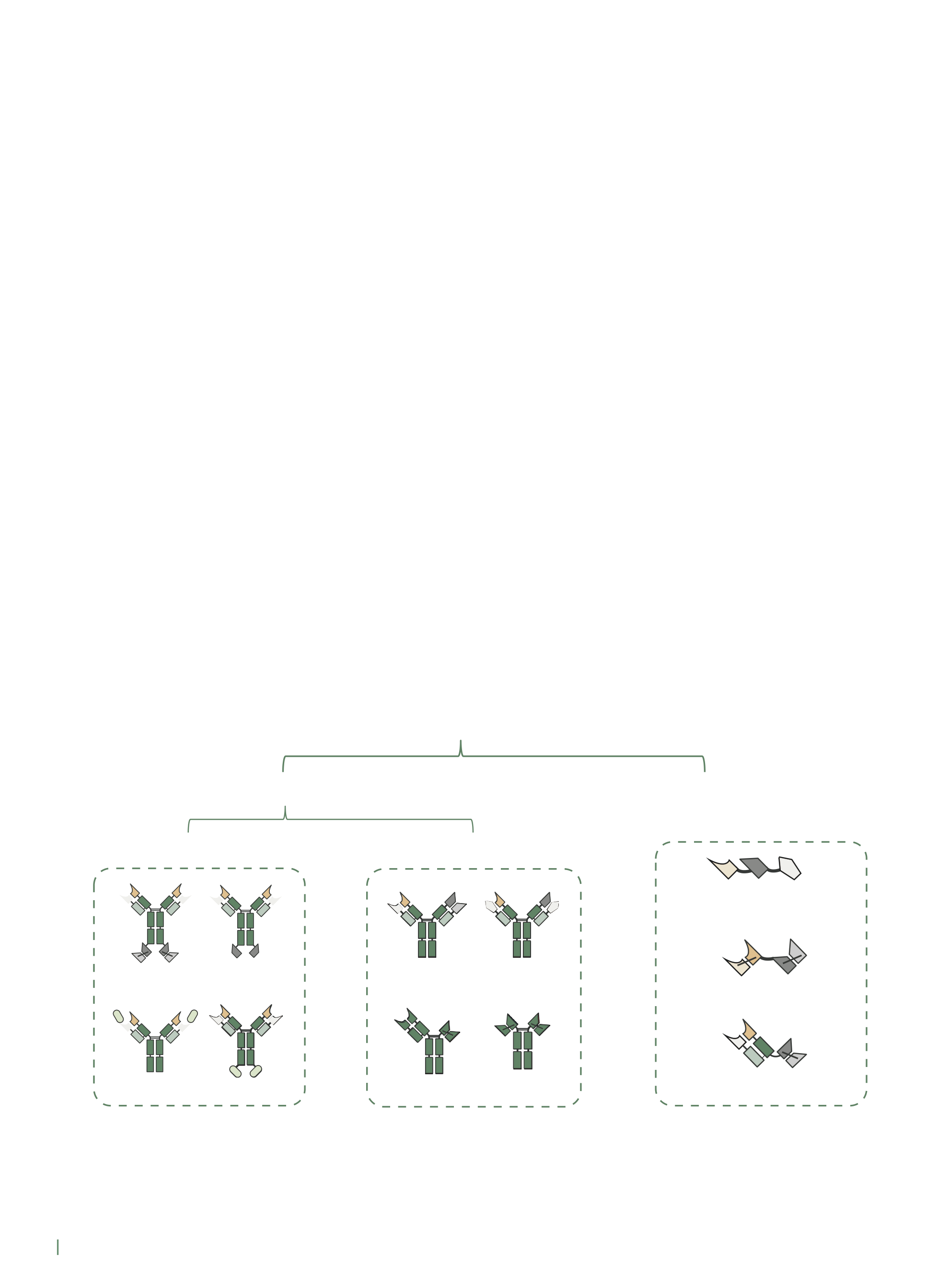 Figure 1
Certain examples of bsAbs produced in ProBio, most of which has got IND approval or pilot scale production
Bispecific Antibody (
bsAb)
IgG
-
like bsAb (bearing Fc)
Fragment based bsAb
(lacking Fc)
Symmetric bsAb
Asymmetric bsAb
IgG
-
scFv
IgG
-
VHH
Protein-IgG
IgG
-
protein
Asymmetric IgG
Fab/scFv
-
Fc
Common LC
scFv1/2
-
(VHH)n
Fab
-
scFv
(
scFv)
n
Bispecific antibodies (bsAbs) are offering innovative approaches for therapeutic efficacy as their potentials to engage
two different targets. They are now being developed for a wide range of therapeutic areas beyond oncology, including
autoimmune diseases, infectious diseases, and neurodegenerative disorders. New formats and designs, which are
targeting beyond two targets but three and more, are expanding the functional capabilities of bsAbs. And enhanced
bsAb producing processes, including 1) two (or more)-vector expression system, 2) intensified fed-batch, 3)
multi-strategy downstream processing, 4) high-concentration formulation, are being optimized for higher yield, lower
mis-matching, and better stability of bsAbs. Having a comprehensive bsAb quality study is essential for the research,
development, and clinical applications of high-quality bsAb. In this white paper, we will show the general idea of designing
the quality study for different bsAb formats, and give several case studies of analytical approaches for asymmetric bsAbs.
The categorization of bsAbs
Generally, bsAbs can be categorized into two major classes, those having an Fc region and those lacking an Fc region. The
former is also referred to IgG-like bsAb while the latter is as known as the fragment-based antibody and normally smaller
than the IgG-like bsAb. The IgG-like bsAb can be assembled from two different heavy and light chains expressed in one
expression system. To avoid a number of nonfunctional molecules in respect to specificity, special designs and
technologies, such as knob-into-hole (KIH), CrossMab, DuoBody, Pentambody, etc. have been emerging to generate
asymmetric IgG-like bsAb. However, the mis-assembled species, especially homodimers, are of utmost importance to be
monitored from the process developed to release testing of final product (and even to the whole shelf life). Unlike
asymmetric IgG-like bsAb, fusion of a second binding moiety, such as scFv, VHH, extra cellular domain of protein, or small
peptide, to the N or C terminus of the heavy or light chain, respectively, of an existing antibody, would be a much simpler
solution for bsAb discovery. Another solution is to get rid of Fc region and genetically fuse the different binding moieties
in a single chain to avoid the mis-assembly in the first place. A classic approach is the BiTE (Bispecific T-cell Engager)
technology, which is the fusion of two scFv fragments in serial, resulting in tandem scFv molecules. And nowadays, besides
scFv fragments, VHH and Fab can also be used as the moieties and multiple moieties can be fused together in one single
chain.
1 Analytical Approach for Bispecific Antibody Quality Study
Figure 1
Certain examples of bsAbs produced in ProBio, most of which has got IND approval or pilot scale production
Bispecific Antibody (
bsAb)
IgG
-
like bsAb (bearing Fc)
Fragment based bsAb
(lacking Fc)
Symmetric bsAb
Asymmetric bsAb
IgG
-
scFv
IgG
-
VHH
Protein-IgG
IgG
-
protein
Asymmetric IgG
Fab/scFv
-
Fc
Common LC
scFv1/2
-
(VHH)n
Fab
-
scFv
(
scFv)
n
Bispecific antibodies (bsAbs) are offering innovative approaches for therapeutic efficacy as their potentials to engage
two different targets. They are now being developed for a wide range of therapeutic areas beyond oncology, including
autoimmune diseases, infectious diseases, and neurodegenerative disorders. New formats and designs, which are
targeting beyond two targets but three and more, are expanding the functional capabilities of bsAbs. And enhanced
bsAb producing processes, including 1) two (or more)-vector expression system, 2) intensified fed-batch, 3)
multi-strategy downstream processing, 4) high-concentration formulation, are being optimized for higher yield, lower
mis-matching, and better stability of bsAbs. Having a comprehensive bsAb quality study is essential for the research,
development, and clinical applications of high-quality bsAb. In this white paper, we will show the general idea of designing
the quality study for different bsAb formats, and give several case studies of analytical approaches for asymmetric bsAbs.
The categorization of bsAbs
Generally, bsAbs can be categorized into two major classes, those having an Fc region and those lacking an Fc region. The
former is also referred to IgG-like bsAb while the latter is as known as the fragment-based antibody and normally smaller
than the IgG-like bsAb. The IgG-like bsAb can be assembled from two different heavy and light chains expressed in one
expression system. To avoid a number of nonfunctional molecules in respect to specificity, special designs and
technologies, such as knob-into-hole (KIH), CrossMab, DuoBody, Pentambody, etc. have been emerging to generate
asymmetric IgG-like bsAb. However, the mis-assembled species, especially homodimers, are of utmost importance to be
monitored from the process developed to release testing of final product (and even to the whole shelf life). Unlike
asymmetric IgG-like bsAb, fusion of a second binding moiety, such as scFv, VHH, extra cellular domain of protein, or small
peptide, to the N or C terminus of the heavy or light chain, respectively, of an existing antibody, would be a much simpler
solution for bsAb discovery. Another solution is to get rid of Fc region and genetically fuse the different binding moieties
in a single chain to avoid the mis-assembly in the first place. A classic approach is the BiTE (Bispecific T-cell Engager)
technology, which is the fusion of two scFv fragments in serial, resulting in tandem scFv molecules. And nowadays, besides
scFv fragments, VHH and Fab can also be used as the moieties and multiple moieties can be fused together in one single
chain.
1 Analytical Approach for Bispecific Antibody Quality Study
 Table 1
An example of specifications for bsAb (part)
Content
Identity
pI by icIEF and/or Peptide
mapping
Assay
Proposed acceptance criteria
Conforms to Reference
Purity/impurities
(size variants)
SEC-HPLC
Main peak (monomer) ≥95.0%
HMWs ≤5.0%
Set numeric limit for %LMWs
CE-SDS-NR
Main peak (monomer) ≥90.0%
Set numeric limit for %Total pre-peaks (LMWs)
May set numeric limit for %Total post-peaks (HMWs)
CE-SDS-R
(no need for single chain
molecules)
HC + LC (purity) ≥90.0%
Set numeric limit for %NGHC or %Total
other impurities if possible
Purity/impurities
(charge variants)
cIEF/icIEF/IEX-HPLC
Set numeric limits for %Acidic peaks, %Main
peak(s), and %Basic peaks
Impurities
(mis-assemblies)
SEC/CE/icIEF/IEX/RP/HIC
Set numeric limits for %mis-assemblies
Safety
ELISA binding potency
70% - 130% to Reference
Cell-based functional potency
60% - 140% to Reference
Protein concentration
Target (mg/mL) ± 10%
Endotoxin
≤ XX EU/mg (Dose dependent)
Bioburden (for DS)
TAMC ≤1 cfu/10 mL; TYMC ≤1 cfu/10 mL
Sterility (for DP)
No growth
Potency
Quantity
As the bsAbs are derived from antibody, a common set of analytical tools for conventional antibody would also be suitable
for the quality control of bsAbs. Those tools generally include SEC-HPLC and CE-SDS for size variants analysis and
cIEF/icIEF/IEX-HPLC for charge variant analysis, which are all for exploring the physicochemical properties of the
molecules. Regarding biological properties, however, things are being complicated since bsAbs are inherently engineered
to engage multiple targets at once. A classic in vitro bioassay strategy would be one ELISA binding potency test involving
dual targets and one functional potency test reflecting the mechanism of action (MOA) of the bsAbs, such as T-cell
engager. And two individual ELISA methods or two individual functional assays can also be applied as in vitro potency
tests.
General considerations for the quality control of bsAbs
ProBioCDMO
.com
2
Table 1
An example of specifications for bsAb (part)
Content
Identity
pI by icIEF and/or Peptide
mapping
Assay
Proposed acceptance criteria
Conforms to Reference
Purity/impurities
(size variants)
SEC-HPLC
Main peak (monomer) ≥95.0%
HMWs ≤5.0%
Set numeric limit for %LMWs
CE-SDS-NR
Main peak (monomer) ≥90.0%
Set numeric limit for %Total pre-peaks (LMWs)
May set numeric limit for %Total post-peaks (HMWs)
CE-SDS-R
(no need for single chain
molecules)
HC + LC (purity) ≥90.0%
Set numeric limit for %NGHC or %Total
other impurities if possible
Purity/impurities
(charge variants)
cIEF/icIEF/IEX-HPLC
Set numeric limits for %Acidic peaks, %Main
peak(s), and %Basic peaks
Impurities
(mis-assemblies)
SEC/CE/icIEF/IEX/RP/HIC
Set numeric limits for %mis-assemblies
Safety
ELISA binding potency
70% - 130% to Reference
Cell-based functional potency
60% - 140% to Reference
Protein concentration
Target (mg/mL) ± 10%
Endotoxin
≤ XX EU/mg (Dose dependent)
Bioburden (for DS)
TAMC ≤1 cfu/10 mL; TYMC ≤1 cfu/10 mL
Sterility (for DP)
No growth
Potency
Quantity
As the bsAbs are derived from antibody, a common set of analytical tools for conventional antibody would also be suitable
for the quality control of bsAbs. Those tools generally include SEC-HPLC and CE-SDS for size variants analysis and
cIEF/icIEF/IEX-HPLC for charge variant analysis, which are all for exploring the physicochemical properties of the
molecules. Regarding biological properties, however, things are being complicated since bsAbs are inherently engineered
to engage multiple targets at once. A classic in vitro bioassay strategy would be one ELISA binding potency test involving
dual targets and one functional potency test reflecting the mechanism of action (MOA) of the bsAbs, such as T-cell
engager. And two individual ELISA methods or two individual functional assays can also be applied as in vitro potency
tests.
General considerations for the quality control of bsAbs
ProBioCDMO
.com
2
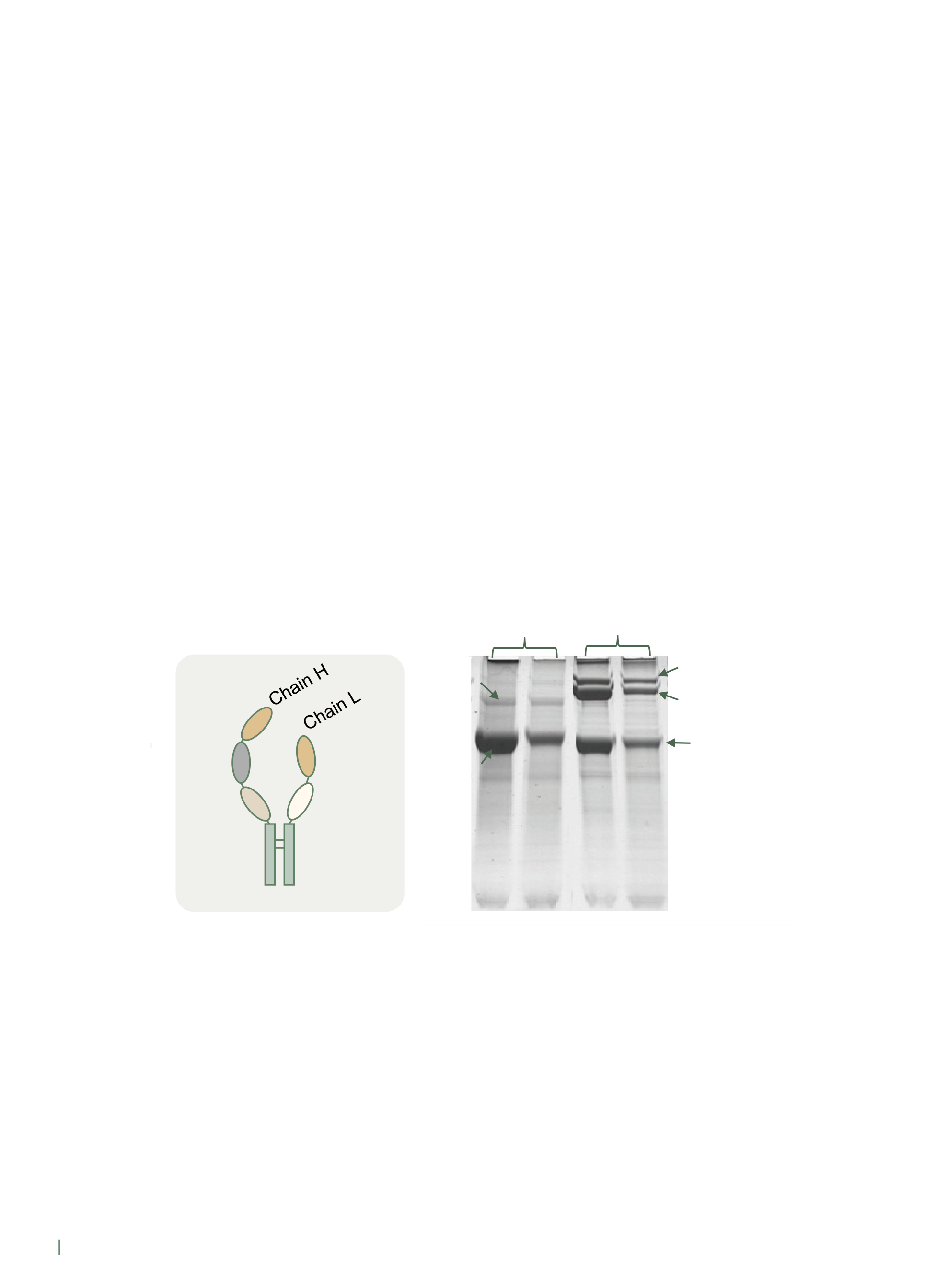 Fig 2
Using SDS-PAGE for asymmetric bsAb analysis
R
NR
Fc
1*Chain L
2*Chain L
Size (or mass)-based analytical approach is one of the easiest way to get the idea of controlling the homodimers. When
we put the order of the size (or mass) that they can distinguish from large to small, the corresponding analytical tools are
listed as SDS-PAGE, SEC-HPLC/CE-SDS, and LC-MS for mass analysis.
SEC-HPLC/CE-SDS
SEC and CE-SDS are powerful quantitative tools to separate the size variants of bsAbs. SEC separates the biomolecules
under non-denatured conditions, having a better resolution of separating aggregates from monomers. CE-SDS separates
the biomolecules under denatured conditions, having a better resolution of separating fragments from monomers. Thus,
in term of distinguishing homodimer from heterodimer, CE-SDS has certain advantage compared to SEC because
CE-SDS eliminates the interference from aggregates and has better resolution in the range of 10kDa level. And these two
approaches are especially useful for the bsAbs bearing highly-glycosylated protein (Figure 3).
Special considerations for the asymmetric bsAbs
Besides the above-mentioned analytical tools, special considerations are needed for the special designed bsAb, that is,
asymmetric bsAbs. Although advanced error-proofing technology has been well developed, certain analytical tools are still
needed to monitor those mis-assembled species, especially homodimers. The strategy of analytical development is
simple and straight-forward but also can be difficult and complicated: to find the difference(s) between the heterogenous
target molecules and the mis-paired homodimers. And the differences could be size (or mass), charge, hydrophobicity,
and others.
Size (or mass)-based analytical approach
For asymmetrical bsAb containing two parts with molecular weights (MWs) of big difference, SDS-PAGE is a
cost-effective choice in the early stage to recognize size variants with the help of MW marker. It is also convenient to run
non-reducing (NR) and reducing (R) conditions on the same gel and to analyze the data in a comprehensive manner by
combining results from both conditions. As shown in Figure 2, the molecule contains chains H and L that have difference
of one >20kDa domain. The R conditions indicate the Chain L is the chain of a dominant amount; and combined with MW
info., it is suggested that the 3 major bands in the NR conditions are L+H, 2*L, and 1*L, respectively.
SDS-PAGE
Chain H
Chain L
Target: Chain L + H
3 Analytical Approach for Bispecific Antibody Quality Study
Fig 2
Using SDS-PAGE for asymmetric bsAb analysis
R
NR
Fc
1*Chain L
2*Chain L
Size (or mass)-based analytical approach is one of the easiest way to get the idea of controlling the homodimers. When
we put the order of the size (or mass) that they can distinguish from large to small, the corresponding analytical tools are
listed as SDS-PAGE, SEC-HPLC/CE-SDS, and LC-MS for mass analysis.
SEC-HPLC/CE-SDS
SEC and CE-SDS are powerful quantitative tools to separate the size variants of bsAbs. SEC separates the biomolecules
under non-denatured conditions, having a better resolution of separating aggregates from monomers. CE-SDS separates
the biomolecules under denatured conditions, having a better resolution of separating fragments from monomers. Thus,
in term of distinguishing homodimer from heterodimer, CE-SDS has certain advantage compared to SEC because
CE-SDS eliminates the interference from aggregates and has better resolution in the range of 10kDa level. And these two
approaches are especially useful for the bsAbs bearing highly-glycosylated protein (Figure 3).
Special considerations for the asymmetric bsAbs
Besides the above-mentioned analytical tools, special considerations are needed for the special designed bsAb, that is,
asymmetric bsAbs. Although advanced error-proofing technology has been well developed, certain analytical tools are still
needed to monitor those mis-assembled species, especially homodimers. The strategy of analytical development is
simple and straight-forward but also can be difficult and complicated: to find the difference(s) between the heterogenous
target molecules and the mis-paired homodimers. And the differences could be size (or mass), charge, hydrophobicity,
and others.
Size (or mass)-based analytical approach
For asymmetrical bsAb containing two parts with molecular weights (MWs) of big difference, SDS-PAGE is a
cost-effective choice in the early stage to recognize size variants with the help of MW marker. It is also convenient to run
non-reducing (NR) and reducing (R) conditions on the same gel and to analyze the data in a comprehensive manner by
combining results from both conditions. As shown in Figure 2, the molecule contains chains H and L that have difference
of one >20kDa domain. The R conditions indicate the Chain L is the chain of a dominant amount; and combined with MW
info., it is suggested that the 3 major bands in the NR conditions are L+H, 2*L, and 1*L, respectively.
SDS-PAGE
Chain H
Chain L
Target: Chain L + H
3 Analytical Approach for Bispecific Antibody Quality Study
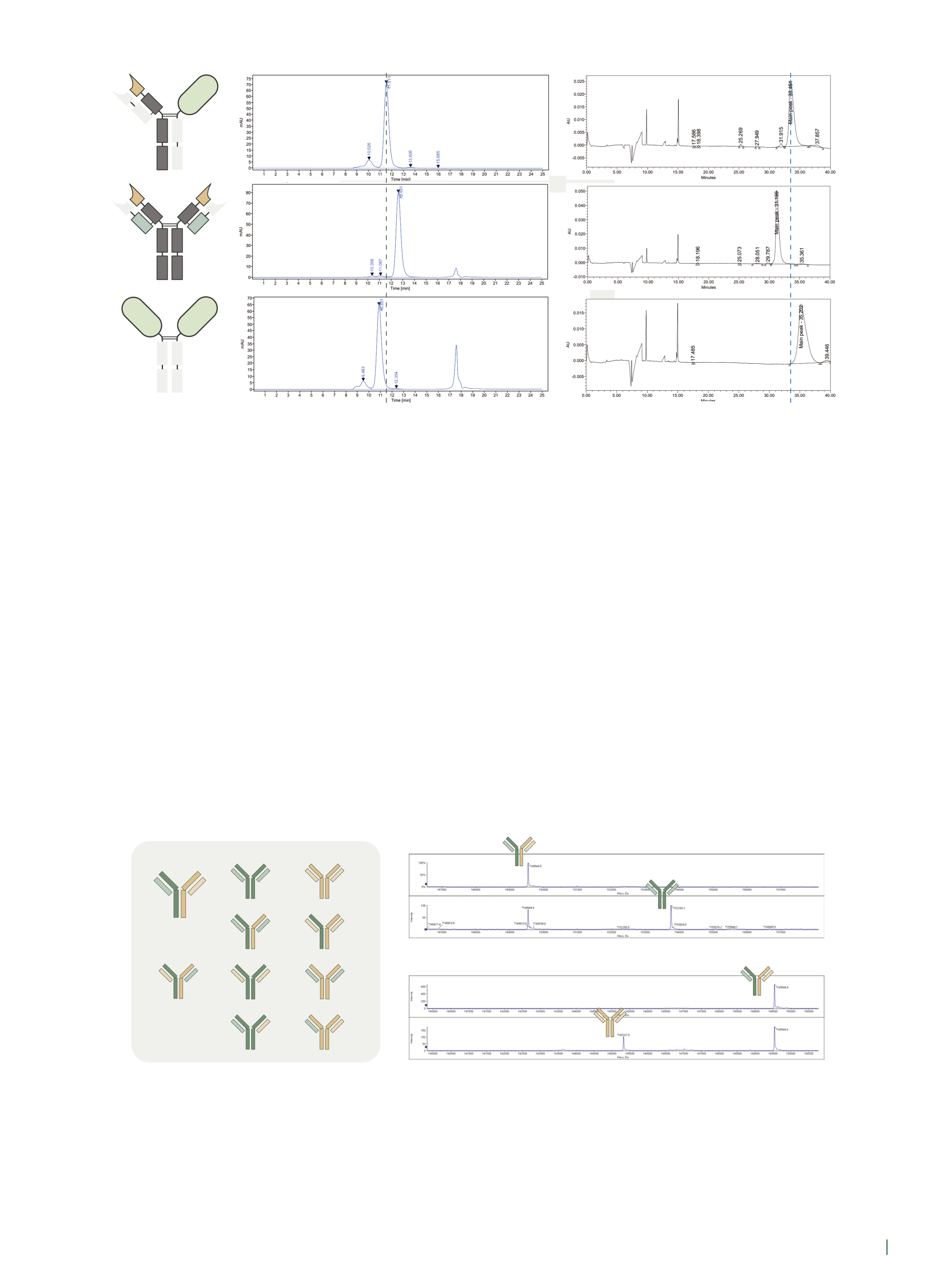 Figure 3
Using SEC-HPLC (left) and CE-SDS (right) for asymmetric bsAb analysis
Fab-Fc x Protein-Fc
heterodimer
Fab-Fc homodimer
Protein-Fc
homodimer
Fab-Fc x Protein-
Figure 4
Using LC-MS for asymmetric bsAb analysis
Fab-Fc homodimer
Protein-Fc
homodimer
Target
(2)
(3)
(4)
(5)
(6)
(1)
(7)
(8)
(9)
H
omodimer1, spiked
Target
Target
Homodimer2, spiked
LC-MS characterizes the protein’s MW in a very high-resolution way, making it one of the most effective analytical tools
to distinguish the mis-assembled species from the target bsAb, even if they have very similar properties of mass, charge,
and hydrophobicity. And before LC-MS analysis, certain pre-treatment, such as removing N-glycan via PNGase F and/or
truncating C-term lysine via CpB, may help to deconvolute the mass to a single one and thus to facilitate the identification
of homodimer/heterodimer.
LC-MS for mass analysis
For a “conventional” asymmetric bsAb composed of two different heavy and light chains, in theory, there will be 9
combinations of mis-pairing besides the correct pairing “Target” (Figure 4). And high-resolution mass spectrometer
(HRMS) is capable to distinguish combinations (1) – (4) as well as (6) – (9) from the Target. Unfortunately, combination
(5) shares the exact same mass with the Target as only light chains are switched in (5). As shown in Figure 5, applying
Papain treatment to obtain Fab subunit followed by LC-MS analysis can monitor the existence of combination (5).
ProBioCDMO
.com
4
Figure 3
Using SEC-HPLC (left) and CE-SDS (right) for asymmetric bsAb analysis
Fab-Fc x Protein-Fc
heterodimer
Fab-Fc homodimer
Protein-Fc
homodimer
Fab-Fc x Protein-
Figure 4
Using LC-MS for asymmetric bsAb analysis
Fab-Fc homodimer
Protein-Fc
homodimer
Target
(2)
(3)
(4)
(5)
(6)
(1)
(7)
(8)
(9)
H
omodimer1, spiked
Target
Target
Homodimer2, spiked
LC-MS characterizes the protein’s MW in a very high-resolution way, making it one of the most effective analytical tools
to distinguish the mis-assembled species from the target bsAb, even if they have very similar properties of mass, charge,
and hydrophobicity. And before LC-MS analysis, certain pre-treatment, such as removing N-glycan via PNGase F and/or
truncating C-term lysine via CpB, may help to deconvolute the mass to a single one and thus to facilitate the identification
of homodimer/heterodimer.
LC-MS for mass analysis
For a “conventional” asymmetric bsAb composed of two different heavy and light chains, in theory, there will be 9
combinations of mis-pairing besides the correct pairing “Target” (Figure 4). And high-resolution mass spectrometer
(HRMS) is capable to distinguish combinations (1) – (4) as well as (6) – (9) from the Target. Unfortunately, combination
(5) shares the exact same mass with the Target as only light chains are switched in (5). As shown in Figure 5, applying
Papain treatment to obtain Fab subunit followed by LC-MS analysis can monitor the existence of combination (5).
ProBioCDMO
.com
4
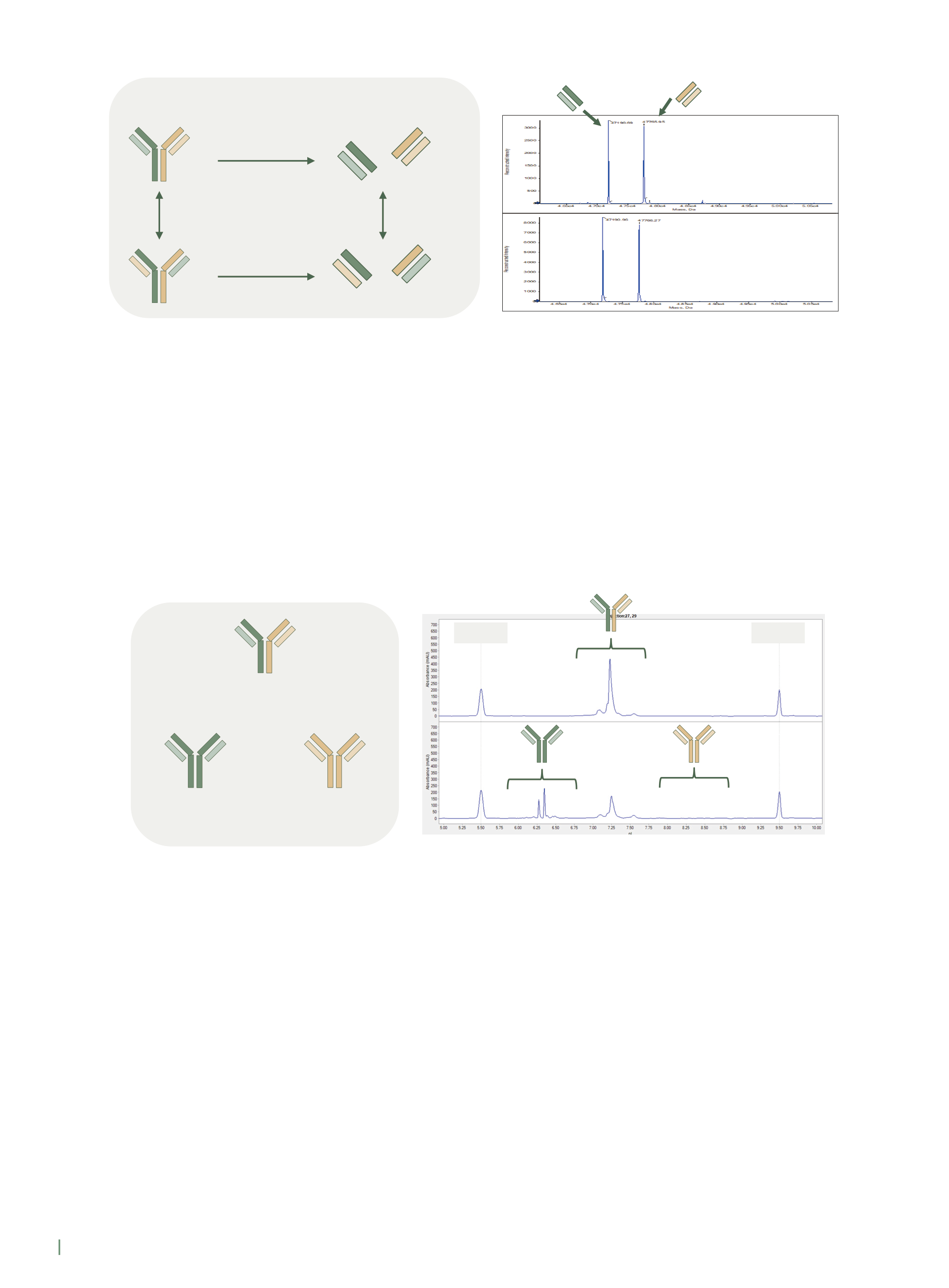 Figure 5
Using LC-MS for analysis of subunits of asymmetric bsAb
Figure 6
Using icIEF for asymmetric bsAb analysis
Papain digestion has been applied to identify (5).
Target
(5)
Same mass
Papain
Papain
Different mass
Not found
Tox batch
GMP batch
Mkr 5.5
Mkr 9.5
Knob/knob,
pI 6.X
Hole/hole,
pI 8.X
Target
Homodimer
Knob-into-hole,
pI 7.X
Charge (or pI)-based analytical approach is highly depended on the sequences of each side of the heterogenous target
molecules. When the sequences to be used in CMC are finalized, their theoretical pI values of individual chains forming
asymmetrical bsAb can be estimated and the suitability of using icIEF to recognize homodimer from heterodimer can thus
be evaluated. Usually a difference more than 1 pI unit between heterodimer and homodimer would be suitable for icIEF
analysis.
Charge (or pI)-based analytical approach
Using the difference in hydrophobicity between heterodimer and homodimer would be subtle since the hydrophobicity is
not easy to be predicted. And the analytical methods, HIC-HPLC, usually need to be polished for a quite long time.
However, if the two difference HC contains different number of glycan sites, HIC-HPLC might be considered in the first
place since glycan will largely contribute to the different hydrophobicity. Besides that, certain efforts are still worth to try
(Figure 7) if the difference in mass or charge cannot be found.
Hydrophobicity-based analytical approach
5 Analytical Approach for Bispecific Antibody Quality Study
Figure 5
Using LC-MS for analysis of subunits of asymmetric bsAb
Figure 6
Using icIEF for asymmetric bsAb analysis
Papain digestion has been applied to identify (5).
Target
(5)
Same mass
Papain
Papain
Different mass
Not found
Tox batch
GMP batch
Mkr 5.5
Mkr 9.5
Knob/knob,
pI 6.X
Hole/hole,
pI 8.X
Target
Homodimer
Knob-into-hole,
pI 7.X
Charge (or pI)-based analytical approach is highly depended on the sequences of each side of the heterogenous target
molecules. When the sequences to be used in CMC are finalized, their theoretical pI values of individual chains forming
asymmetrical bsAb can be estimated and the suitability of using icIEF to recognize homodimer from heterodimer can thus
be evaluated. Usually a difference more than 1 pI unit between heterodimer and homodimer would be suitable for icIEF
analysis.
Charge (or pI)-based analytical approach
Using the difference in hydrophobicity between heterodimer and homodimer would be subtle since the hydrophobicity is
not easy to be predicted. And the analytical methods, HIC-HPLC, usually need to be polished for a quite long time.
However, if the two difference HC contains different number of glycan sites, HIC-HPLC might be considered in the first
place since glycan will largely contribute to the different hydrophobicity. Besides that, certain efforts are still worth to try
(Figure 7) if the difference in mass or charge cannot be found.
Hydrophobicity-based analytical approach
5 Analytical Approach for Bispecific Antibody Quality Study
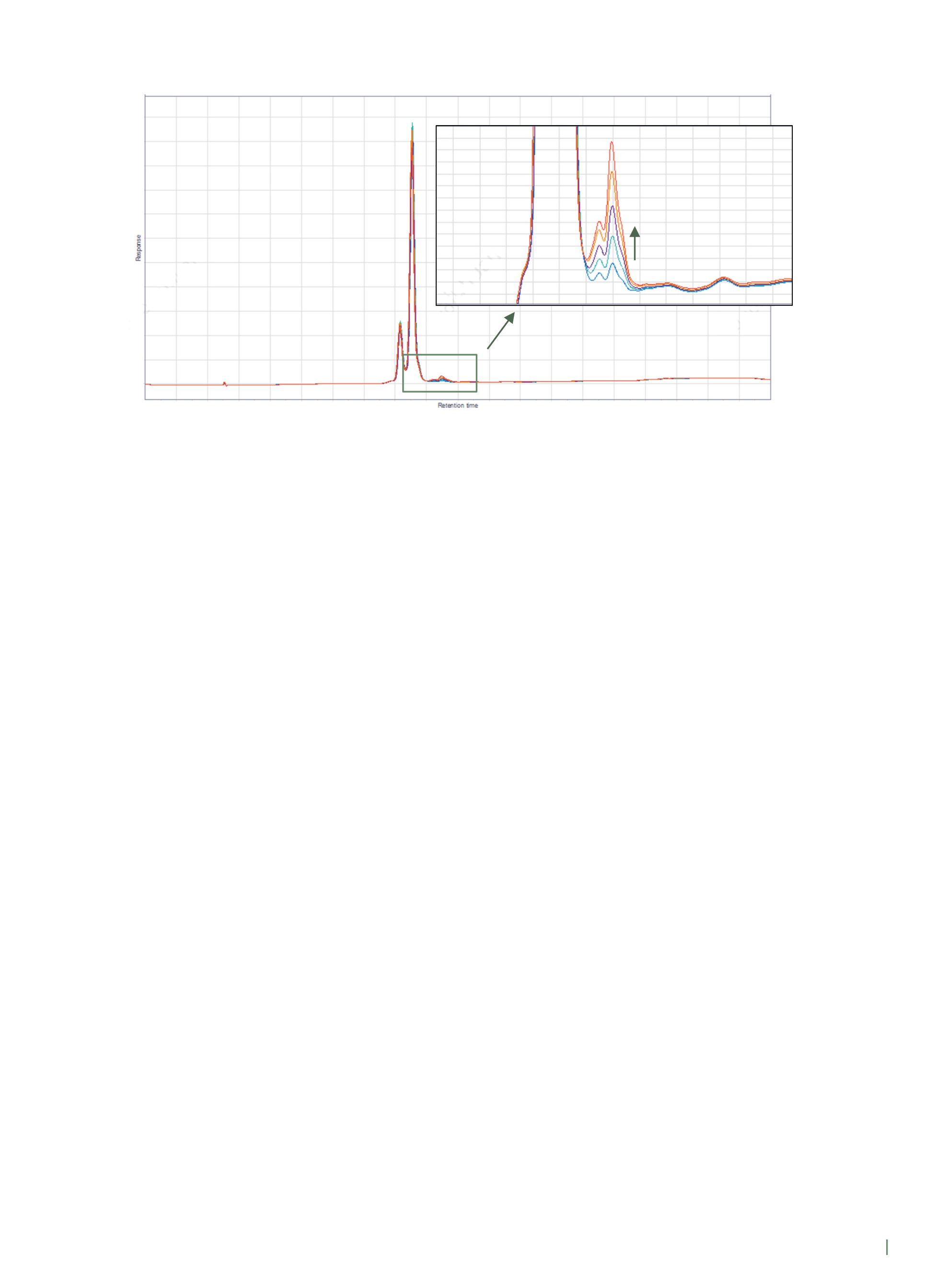 Figure 7
Using HIC-HPLCF for asymmetric bsAb analysis
The analytics for bsAb is a complex, multidisciplinary effort that requires collaboration among antibody discovery
scientists, process development scientists, analytics scientists, and regulatory experts to guarantee the safety,
effectiveness and controllable quality of these innovative biologics. Although many analytical methods can be directly
taken from the those for conventional antibody, the potency assays as well as the special methods for mis-paired species
are the key to the success of the analytics of bsAbs. ProBio has extensive experiences and industry-leading expertise on
the analytics of bsAbs, which has been and will be successfully supporting the clients for their IND and BLA applications.
Summary
ProBioCDMO
.com
6
Enlarged
Spiked homodimer
HIC-HPLC
Figure 7
Using HIC-HPLCF for asymmetric bsAb analysis
The analytics for bsAb is a complex, multidisciplinary effort that requires collaboration among antibody discovery
scientists, process development scientists, analytics scientists, and regulatory experts to guarantee the safety,
effectiveness and controllable quality of these innovative biologics. Although many analytical methods can be directly
taken from the those for conventional antibody, the potency assays as well as the special methods for mis-paired species
are the key to the success of the analytics of bsAbs. ProBio has extensive experiences and industry-leading expertise on
the analytics of bsAbs, which has been and will be successfully supporting the clients for their IND and BLA applications.
Summary
ProBioCDMO
.com
6
Enlarged
Spiked homodimer
HIC-HPLC
 ProBioCDMO
.com
ProBio Inc.
Building 9, 311 Pennington Rocky Hill Rd,
Pennington, NJ
+1-732-885-9188 (US)
ProBioCDMO
.com
ProBio Inc.
Building 9, 311 Pennington Rocky Hill Rd,
Pennington, NJ
+1-732-885-9188 (US)